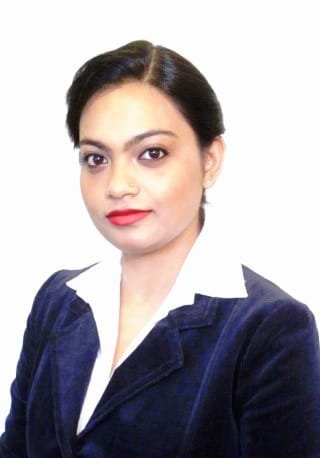
About me

A scientist, writer and teacher connecting complex ideas with the people who need them

I am Dr. Madhuleena Dasgupta, a computational neuroscientist and educator based in Hamburg. My work brings together brain science, mathematical modelling, scientific communication and teaching.

Dr. Madhuleena Dasgupta writing at her desk by a window

My academic journey

From engineered systems to the dynamics of the brain

My route into computational neuroscience began with an MSc in Micro and Nano Systems at Technische Universität Chemnitz in Germany. That training gave me a foundation in modelling, systems and engineering at very small scales — and led naturally towards a question of extraordinary complexity: how can mathematical and computational methods help us understand the living brain?

I went on to complete a PhD in Computer Science (Health Informatics) at Liverpool Hope University in the UK, supported by a Vice-Chancellor’s Scholarship. My doctoral research investigated brainstem–thalamic circuitry, cholinergic signalling and computational markers associated with early visuomotor impairment in Alzheimer’s disease.

I am currently a Research Fellow with Liverpool Hope University’s School of Computer Science and the Environment. My research lies at the intersection of computational neuroscience and mathematical modelling, with a particular interest in neural-circuit dynamics, neurotransmitter-mediated processes and astrocyte–neuron networks.

Research

Computational models of neural function, disruption and repair

Best Paper of the Session 7th International Conference on Soft Computing for Problem Solving, 2017.
Best Paper of the Conference Recognition for the brainstem cholinergic modelling study at SocProS 2017.
Interdisciplinary research Bringing together computer science, mathematical modelling, neuroscience and experimental evidence.

Why writing and teaching?

Understanding grows through explanation

Interdisciplinary research constantly requires translation: between biology and mathematics, models and experiments, specialists and non-specialists.

That experience shapes both sides of my work. In scientific writing, I look for the clearest way to preserve complex meaning for a chosen audience. In teaching, I begin with what the learner understands and build carefully from there. Neither process is about making a subject artificially simple; it is about making the route through it visible.

Teaching experience

University teaching alongside research

From 2017 to 2019, I worked as a Graduate Teaching Assistant at Liverpool Hope University, including delivering first-year Computer Science seminars. Working with students at the beginning of their university studies strengthened my commitment to supportive, approachable teaching.

Explore teaching and tutoring

How I work

Rigorous with the subject, supportive with the person

Accuracy before simplification

Clear communication should preserve evidence, uncertainty and technical meaning rather than smoothing them away.

The audience shapes the explanation

A journal reader, interested member of the public and first-year student need different routes into the same idea.

Questions are part of the work

Whether editing a manuscript or teaching a learner, constructive questions help expose assumptions and strengthen understanding.

Selected credentials

Academic and professional background

  • Current Research Fellow School of Computer Science and the Environment, Liverpool Hope University
  • PhD Computer Science (Health Informatics) Liverpool Hope University, UK · Vice-Chancellor’s Scholarship
  • MSc Micro and Nano Systems Technische Universität Chemnitz, Germany
  • 2026 Published in IEEE Transactions on Computational Biology and Bioinformatics Computational modelling of astrocyte-driven repair in Alzheimer’s thalamic circuitry
  • 2017 Best Paper of the Session and Best Paper of the Conference 7th International Conference on Soft Computing for Problem Solving
  • 2017–19 Graduate Teaching Assistant Liverpool Hope University, including first-year Computer Science seminars
  • Languages English and Bengali (native); German Teaching can be conducted in English or German

Which kind of support are you looking for?

I work with researchers and organisations on scientific communication, and with learners seeking supportive English and STEM tuition.